Beyond stocks and bonds: a core portfolio for an evolving world

For decades, investing had a simple recipe for most people: put some money in shares for growth, some in bonds for safety, and let the two balance each other out. The famous “60/40” portfolio. When shares fell, bonds were supposed to cushion the fall. For a long time, that recipe worked.
But the world it was designed for has changed. Markets have become more concentrated, with a handful of giant companies driving much of the return. Government and Central Bank policy have become harder to predict. And in recent years, shares and bonds have sometimes fallen together, exactly when investors of the 60/40 portfolio needed them to behave differently.
None of this means diversification is dead. It means diversification has evolved, and the investment team from the BlackRock Global Allocation Fund have taken note of this.
One fund, many engines
The simplest way to understand this fund is to picture an aircraft with several engines instead of one. If a single engine loses power, the others keep the plane flying. Global Allocation is built the same way: it runs several different “engines” of return inside one portfolio, so that when one struggles, the others can do more of the work.
What are those engines?
- Global equities, chosen through two complementary lenses – human conviction and data-driven models working together
- A flexible bond toolkit that ranges far wider than a typical bond fund.
- And a small allocation to alternative investments, such as gold and even shares in companies that aren’t yet listed on a stock exchange.
The point of all this isn’t to chase the single best idea. It’s resilience: not putting everything on one bet. The fund explicitly seeks to deliver equity like returns with lower ups and downs along the way[1].
How it’s different from simply tracking the market
Passive investing has real strengths: it’s cheap, simple, and transparent. For many goals it’s an excellent choice, and nothing here is an argument against it.
But a passive approach has a built in feature that surprises a lot of people: it gives the biggest weight to whatever has already risen the most. The more a company’s share price climbs, the larger it becomes in the index, and the more of it you automatically own. You end up most exposed to yesterday’s winners, precisely when they may be most expensive.
An actively managed fund can do the opposite. It can lean away from crowded, expensive parts of the market and towards areas it believes are better value, including regions, sectors and asset types that an index may leave out entirely. That freedom can help, and at times it can hurt: an active manager who avoids a hot stock will lag while that stock keeps rising. The trade off is the whole point. You are paying for judgement, not for a mirror of the market[2].
There’s a deeper difference too. In an index fund, positions are sized mechanically by how large a company has already become. In Global Allocation, every position has a deliberate purpose: it’s there because the team decided it should be, at the size they chose, for a reason they can explain. Intentional, not accidental.
Equities – growth through multiple lenses
Equities are Global Allocation’s main growth engine. How the fund invests, however, is where it starts to look different from a typical fund. Rather than relying on a single approach, it views the equity market through multiple lenses at once mainly via its fundamental and systematic capabilities[3].
Alongside high conviction stock picking sits a systematic, data driven engine that looks at the same market through a completely different lens: dozens of signals scanning thousands of companies for patterns a human eye can miss. The two aren’t run in separate boxes. The systematic lens can test and challenge the stock pickers’ assumptions (and vice versa), flag where risk is quietly building and help decide how large each position should be. It can also lean gently against the companies the team finds least attractive, not just towards the ones it likes. The result is equity exposure that’s deliberately built, not accidentally inherited.
Why two lenses rather than one? Because no single style works in every market. An individual’s judgement and a model’s discipline can be strong in different conditions, and each can help guard against the other’s blind spots. Blending them aims to make the equity exposure more resilient and steadier across changing markets rather than dependent on one person, or one approach, being right at the right time.
Making the bonds work harder
Now, looking more closely at the Fixed Income part of the Fund, here’s something genuinely counterintuitive. Most people think of bonds as the dull, safe part of a portfolio. But traditional bond indices are built in a slightly strange way: they give the biggest weight to whoever has borrowed the most. The more debt a government or company issues, the bigger its slice of the index.
Think about that. In the equity world, the index rewards the most valuable companies. In the bond world, the index effectively rewards the most indebted ones. For years, that was fine; debt was cheap. But since 2022[4], rates have surged. Now, every time a company’s old debt expires, and when they need to borrow again, they do so at a much higher cost. And the index makes a passive fund own the biggest borrowers of all.
And the mismatch is larger than it looks. There are roughly 50,000 listed companies in the world, but there are around 1.4 million individual bonds[5]. Fixed income is by far the bigger, more fragmented of the two universes.
Global Allocation takes the nuances of Fixed Income into consideration. Alongside traditional government and high quality bonds, it looks across a much broader fixed income universe; areas like high yield credit[6], asset backed securities[7] and emerging market debt, searching for income rather than just holding a defensive anchor. The team’s own philosophy is to “make a little bit of money, many times,” rather than relying on a single big bet.
Going beyond the benchmark in fixed income
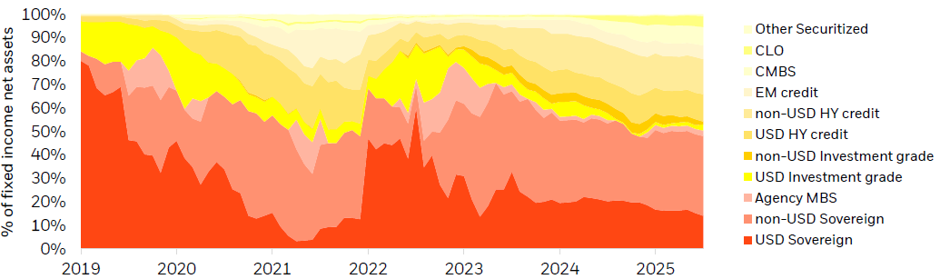
Source: BlackRock. As of 31 October 2025. Subject to change. The fund is actively managed and its characteristics will vary. 1.Rick Rieder joined the Global Allocation Investment Team on 1 April 2019. *% of net assets represents the fund’s exposure based on the economic value of securities and is adjusted for futures, options and swaps (except with respect to fixed income securities) and convertible bonds. For Illustrative Purposes only.
It’s worth being clear eyed: widening the bond toolkit this way adds credit risk and can reduce liquidity, not just potential income. This isn’t a free lunch. But it does turn what many investors treat as the boring part of a portfolio into a potential source of return, used selectively, and actively managed.
Tomorrow’s winners aren’t all on the stock exchange (yet)
Now for the part that most investors never get to see.
A growing number of the world’s most interesting companies are staying private for far longer than they used to. Fewer are rushing to list on a stock exchange, and many are reaching enormous scale while still privately owned. For an investor who only holds a standard index fund, these companies are simply invisible; you can’t own what isn’t listed.
Annual US IPOs and Share Buybacks
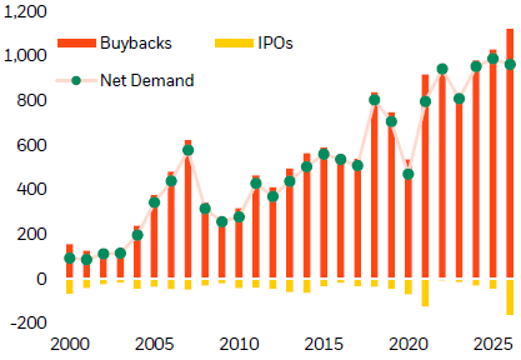
Source: BlackRock; IPO/buyback data and PM Insights, as at 18 February 2026. For illustrative purposes only. The examples shown are illustrative of the type of opportunity and do not represent holdings of the fund.
As the chart above shows, share buybacks; companies repurchasing and retiring their own shares, has consistently outpaced new listings via IPOs (Initial Public Offerings). The result is that the pool of publicly listed shares is shrinking, while more of the economy’s growth is happening in companies that remain privately owned.
Because Global Allocation has a flexible mandate, it can hold a small[8], disciplined slice of private companies alongside its public investments. Over the past 13 years, the strategy has held more than 30 such private holdings before they became household names; including Twitter, Uber and Mobileye[9].
This deserves an honest health warning. Private holdings are a small portion of the fund, and unlisted investments carry their own risks: they can be harder to value and harder to sell than public shares. They are a complement to the portfolio, not its engine. But they are a window onto opportunities a passive approach can’t reach.
The fund that adapts
Markets never sit still. Interest rates move, geopolitics shifts, technology cycles turn. In theory, an engaged investor would respond to all of this by constantly rebalancing. In practice, almost none of us have the time, the tools, or the resources to do that well.
This is perhaps the most practical argument for professional active management. When the team’s view changes, the portfolio changes. To take a recent, concrete example: the managers have trimmed the fund’s gold exposure and shortened its sensitivity to interest rates as conditions evolved; the kind of active, ongoing housekeeping that’s hard for an individual to replicate at home[10].
This isn’t a one person operation, but it is neither a patchwork of outside managers stitched together. The fund is led by Rick Rieder, one of BlackRock’s most senior investors, alongside Russ Koesterich, with a team of 30+ investment professionals dedicated to Global Allocation itself, spanning macro, fundamental, thematic and systematic expertise. And on the bond side, the fund isn’t buying in specialist help at arm’s length: Global Allocation sits directly inside BlackRock’s Global Fixed Income platform; the platform Rick Rieder runs, giving it first hand access to 400+ fixed income specialists who research the market issuer by issuer.
That structure matters more than it sounds. Because Global Allocation is part of the same platform rather than a customer of it, there are no internal walls to work around, and nothing has to be handed off to a separate manager or “sleeved out.” This is not a “fund of funds.” It’s a single, integrated portfolio where the people making the macro call[11], picking the stocks and choosing the bonds all sit together. And those decisions follow a clear order. It starts at the top, with the big picture: where the world is in its economic cycle taking in growth, inflation, interest rates and policy. That view sets how much the fund holds in shares, in bonds and in other assets, and in which regions. Only then does the team choose the individual holdings that best express it. Because the big picture view comes first and one team acts on it together, a change of mind at the top can reshape the whole portfolio, not just one corner of it. (It runs both ways, too: what the specialists see on the ground feeds back and sharpens the big picture view.)
Of course, active management cuts both ways. A team making active decisions can add value and can also get those decisions wrong and underperform a simple market index over a given period. Adaptability is a feature of the process, not a promise of the outcome.
What the track record tells you
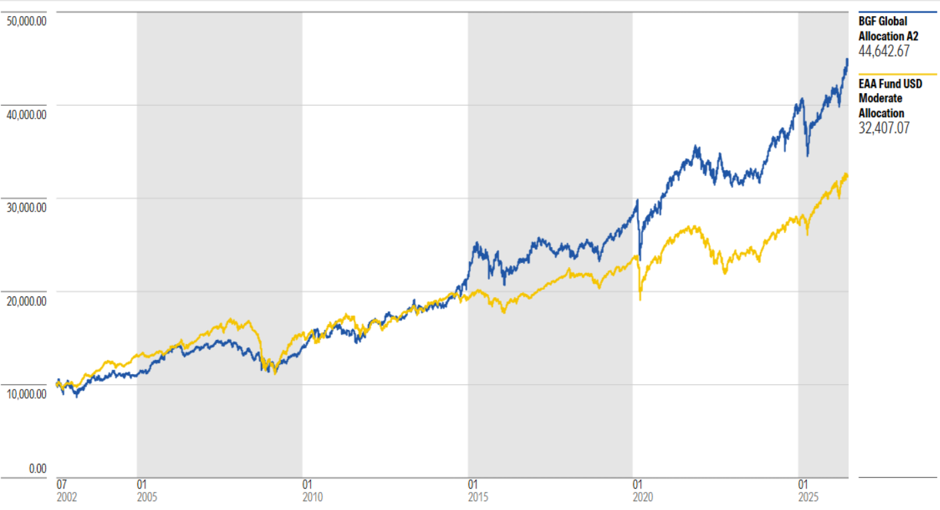
Source: Morningstar Direct for the referenced ISIN LU0171283459 (Class A2 EUR), 31 July 2002 -30 June 2026. Both series are shown in euro, net of ongoing fund charges and excluding entry costs, distribution fees and taxes. “USD” in the category name refers to the base currency of the funds comprising the Morningstar EAA Fund USD Moderate Allocation category, shown here as a peer reference for funds of a similar risk/return profile; the category average is not directly investable. Past performance is not a reliable indicator of future results.
As shown in the chart just above, from 31st of July 2002 until the 30th of June 2026, the portfolio generated a performance of 346.43% net of management fees. The chart also illustrates several periods of market drawdown over this timeframe, including the 2008 global financial crisis and the COVID-19 pandemic; a reminder that this figure reflects a long term investment horizon of nearly 24 years[12].
How to think about this fund
Global Allocation is not a bet on a single theme, a single region, or a single market story. It’s the opposite: a single, broadly diversified, actively managed position intended to work as a core[13] building block; a starting point or steady centre for a portfolio, around which an investor can add more specific holdings if they wish[14].
It may suit an investor who believes diversification still matters but recognises the old 60/40 formula needs an upgrade; who wants their bonds working harder, not just sitting still; who’d like a window onto opportunities a passive fund can’t reach; and who would simply rather have an experienced team adapting the portfolio than do it themselves.
The rules of diversification have changed. Fixed income can be a real source of return when it’s used differently. And many of tomorrow’s winners aren’t public yet. Global Allocation is one fund designed to respond to all three; not by promising more, but by being built differently.
Risk Profile
Significant risks not adequately reflected in the risk and reward profile:
- Credit risk: The fund can invest in bonds. The issuers of these bonds may become insolvent, thus the value of the bonds may be lost in full or in part. If the bonds are high yield, the risk is higher.
- Counterparty risk: If a fund counterparty becomes insolvent, it can no longer, or only partially, pay outstanding obligations. When the fund uses derivatives, this risk may be amplified.
- Derivatives risk: The fund may enter into derivative transactions. The higher profit opportunities thus created are associated with higher risks of loss, which in some cases may be more than you originally invested. The use of such instruments may involve specific liquidity risks, credit risks, counterparty risks, legal risks, valuation risks, operational risks and risks related to the underlying assets.
- Liquidity risk: The fund may invest in securities that are not easily tradable on a stock exchange or similar market. This could affect the fund’s ability to repay investors.
- Emerging market risk: The fund will be more volatile because these markets are typically smaller, less liquid and more sensitive to economic and political factors.
- Currency Risk: The fund can be adversely affected by exchange rate fluctuations.
More information on risks can be found in the KID or in the prospectus.
When investing in the product featured in this article, you may lose some or all of the money you invest. The value of your investment may go down, as well as up. Any income you get from this investment may go down, as well as up. This product may be affected by changes in currency exchange rate movements thereby affecting your investment return therefrom. The performance figures quoted refer to the past and past performance are not a guarantee of future performance or a reliable guide to future performance. A commission or sales fee may be charged at the time of the initial purchase for an investment. Any decision to invest should always be based upon the details contained in the Prospectus and Key Information Document (KID), which may be obtained from MeDirect Bank (Malta) plc
MeDirect Bank (Malta) plc, company registration number C34125, is regulated by the Malta Financial Services Authority and is licensed to undertake the business of investment services under the Investment Services Act (Cap. 370). Terms and Conditions apply and are available upon request.
MeDirect Bank (Malta) plc, The Centre, Tigné Point, Sliema, TPO 0001, Malta.
[1] The fund’s objective, as set out in its Key Information Document, is to maximise the return on your investment through a combination of capital growth and income. The investment team’s stated ambition in pursuing that objective is to deliver equity like returns with a smoother ride than equity markets alone; though, as with any investment, that ambition is not guaranteed, and the value of your investment can fall as well as rise.
[2] And that judgement goes both ways. Alongside the companies it likes, the fund also bets against a smaller group it doesn’t; positions that make money if those companies fall. At the same time, if a company it bet against keeps rising instead of falling, that bet loses money.
[3] Fundamental vs systematic (equity styles): “Fundamental” investing means selecting individual stocks through in-depth research and analyst judgement. “Systematic” investing uses quantitative, data-driven models to identify patterns across large numbers of securities.
[4] The US Federal Reserve hiked rates at the fastest pace in over 40 years, and the ECB followed, raising rates by 4.5 percentage points in just over a year; the fastest tightening in its history
[5] Source: BlackRock 31st May 2026
[6] High-yield credit: Bonds issued by companies or governments with a lower credit rating than investment-grade borrowers. They typically pay a higher rate of interest to compensate for the greater risk that the issuer may struggle to repay.
[7] Asset-backed securities: Bonds backed by a pool of underlying assets, such as loans, mortgages or receivables, rather than by a single borrower’s general creditworthiness. Repayment depends on the cash flows generated by that underlying pool.
[8] Achieved within the Fund’s standard mandate (equity securities of small and emerging growth companies), subject to the general UCITS limit of a maximum 10% of net assets in instruments not listed or traded on a regulated market. This is an opportunistic feature of the strategy, not a dedicated private markets allocation, and is not guaranteed to recur.
[9] Source: BlackRock, data as at 31 October 2025. Companies named are historical examples of private holdings over the manager’s tenure and are referenced only to illustrate the strategy; they are not a recommendation and do not represent all holdings.
[10] The above reflects the views and positioning of the BlackRock Global Allocation portfolio management team as at 31 May 2026, does not constitute investment advice or a recommendation regarding any specific security or strategy, and is subject to change.
[11] The “macro call” refers to the big-picture decisions about how the portfolio should be positioned given the broader economic and market outlook, for example how much to hold in equities versus bonds, or which regions and sectors look more or less attractive. This is distinct from stock and bond selection, which is about picking the individual securities that fill out those broader positions.
[12] Past performance is not a reliable indicator of future results, and your capital is at risk. You may get back less than you invested.
[13] A foundational holding within a portfolio, as opposed to a satellite or thematic position. A core holding is typically diversified, liquid, and intended to provide stable, long-term exposure to a broad theme or market. It represents a larger share of the overall portfolio and is expected to be held through multiple market cycles rather than traded tactically.
[14] The recommended holding period for this fund is 5 years, and it is intended for investors who are able to bear losses up to the amount invested. The fund carries a summary risk indicator of 3 out of 7 (medium-low risk class), assuming the product is held for 5 years